
Incubated startups
You have a pitch and a slide with a render. You need something that switches on in front of a panel.
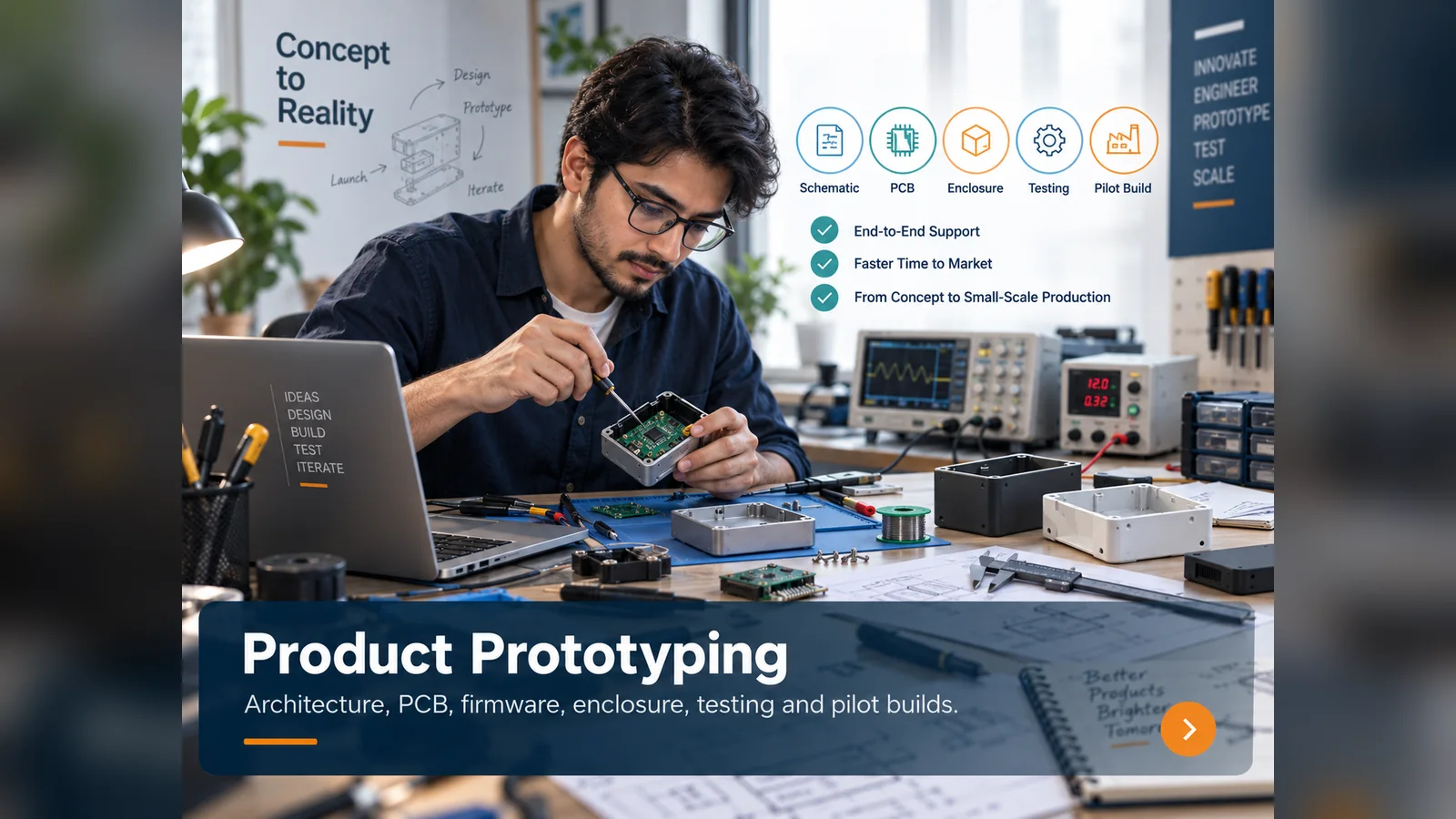
For startup teams, incubatees, research groups and departments taking a concept toward a working product — schematic to PCB to firmware to enclosure to a small pilot batch.
Everything you send stays confidential. Manuscripts, theses, data and code are used only for your job — never shared, never resold, never reused for anyone else. NDA on request. How we handle your files
The order is deliberate: the expensive irreversible steps come after the cheap reversible ones.
What it senses, controls, logs or sends. Environment, power source, cost ceiling and volume.
Block diagram, controller and module selection, power budget, costed BOM and risk list.
The riskiest subsystem is built and measured first, before anything is committed to copper.
Schematic, layout, fabrication, assembly and bring-up — with test points designed in from the start.
Application logic, connectivity, calibration and a printed or machined housing that fits.
Small batch, test report, user guide, and all source, board and CAD files handed to you.
You have a pitch and a slide with a render. You need something that switches on in front of a panel.
A published method that needs a physical demonstrator for a funding review or a field trial.
An existing product that needs a variant, a cost-down, or a redesign around a part that went obsolete.
A centre of excellence that needs demonstrable, working hardware rather than a poster.
No locked files, no dependency on us to make the next revision. If you want to take it to a manufacturer, you can.
Schematic and PCB source (KiCad or Altium), Gerbers, drill files, pick-and-place and a fabrication-ready package.
Full commented source, build instructions, toolchain notes and the flashing procedure.
STEP and STL files for the enclosure, print or machining settings, and assembly notes.
Every part with manufacturer part number, supplier, quantity, unit cost and at least one alternate.
What was measured, under what conditions, with the raw logs — not a claim without evidence.
A short guide for whoever operates it, written for the person, not for the engineer.
A prototype price is dominated by three things we cannot guess: how many unknowns are in the design, what the components cost this month, and how many revisions the design needs before it holds. A soil-moisture node and a three-phase energy analyser are both “an IoT prototype” and differ by an order of magnitude.
Each gate is priced separately. You can stop after any gate, with everything produced up to that point handed over.
Parts and fabrication are billed at what they cost, with invoices. Our fee is engineering time, not a margin on a sensor.
The requirements and architecture gate is deliberately low-cost. It tells you what the whole thing will cost before you commit to it.
Describe what it should do and who uses it. An NDA first is fine — just say so.